When Learning Competes with Living
In Development as Freedom, Sen (1999) argued that poverty is a deprivation of the capabilities and substantive freedoms required for a person to participate meaningfully in society. In the context of education, this perspective suggests that socioeconomic disadvantage may limit children's opportunities to develop their capabilities through learning. For instance, students whose parents have lower educational attainment may be less likely to consider pursuing higher education due to a lack of family experience of it (Blanden et al., 2022; Lasselle and Smith, 202). Such disadvantage is also reflected in how well students do at school. In Malaysia, OECD (2026) reported that only 10% of socioeconomically disadvantaged students scored in the top quartile of science performance, compared with 12% on average across participating countries. Together, these may constrain which students can realistically consider pursuing higher education.
Intergenerational Mobility and the Role of Education
The relationship between parental background and children's future outcomes has been widely discussed in the literature on intergenerational socioeconomic mobility. Corak (2013) illustrates a positive association between income inequality and the persistence of economic status across generations, known as the "Great Gatsby Curve" (Krueger, 2012). This relationship raises concerns about the extent of education facilitate upward mobility. While education is often viewed as "the great leveler", access to its benefits may itself be unequally distributed. For instance, Blanden et al. (2012) show that educational attainment immobility is positively related to income inequality across both developed and developing countries. Understanding on how educational inequalities arise is therefore essential to explain the persistence of socioeconomic disadvantage across generations.
While educational attainment concerns the highest level of education an individual complete, educational achievement refer to their performance throughout the educational process. These two dimensions of educational outcome in education outcomes are closely related, as differences in academic achievement may shape subsequent educational progression (Bukodi et al., 2021). Bittmann (2024) find that early academic performance is associated with family socioeconomic status, which subsequently influences students' opportunities for progression to higher education. This highlights how inequalities in academic achievement may reinforce educational disparities and contribute to the intergenerational persistence of socioeconomic disadvantage.
Parental Education and Inequalities in Academic Achievement
Parental educational attainment is an important aspect of family socioeconomic background that may influence children's academic achievement. Parents with higher educational attainment may possess more familiarity with education pathways, institutional requirements and opportunities to further study, which allow them to provide informed guidance on academic decision (Foster and van de Werfhorst, 2020). Such institutional knowledge is a form of cultural capital that may complement the accumulation of human capital among children. For instance, university faculty members are disproportionately more likely to have a parent holding a PhD compared to general population (Morgan et al., 2022). Geven and Zwier (2025) further argued that knowledge on education system is positively correlated to students' test performance. Consequently, difference in parents' accumulated educational knowledge and institutional familiarity may contribute to the persistence inequalities in children achievement and subsequently educational progression.
Beyond parental involvement, family socioeconomic circumstances may also shaped the resources available for children. Student from more advantaged household may have greater access to educational material and conducive environment for academic development. von Stumm et al. (2022) found that family socioeconomic circumstances and academic achievement are correlated and persisted throughout children's schooling. These mechanisms suggest that parental education may influence children's academic achievement through institutional knowledge and guidance, complemented by the material resources available within the household.
The Role of Educational Institution in Reducing Achievement Gaps
Although family background is an important determinant of children's academic achievement, schools may play a compensatory role by providing learning opportunities and educational support that are less available for students from disadvantaged households. Foliano et al. (2019) find that students from disadvantaged socioeconomic backgrounds attending boarding schools achieve better academic outcomes than comparable students attending selective day schools. Complementing this finding, Sheehan and Hadfield (2024) further demonstrated that supportive school environments help disadvantaged students overcome barriers to academic success. This suggests that school-based support could partially substitute for difference in family support, and potentially mitigate educational inequality associated with socioeconomic background.
However, the extent to which schools can fulfill this compensatory role depends on the resources available to them. Yet these resources are often distributed inequitably. As highlighted by Lee et al. (2022), disadvantaged student may receive more school funding but disproportionately having more inexperienced teachers. Furthermore, socioeconomically privileged students tend to benefits more from high-quality teacher than their disadvantaged peers (Yang and Lee, 2022). Taken together, these findings suggest that greater school expenditure does not necessarily translate into improved educational opportunities for disadvantaged students if the allocation of teaching resources and educational outcomes remain unequal.
Conclusion
Anchored in Sen's capability approach, educational achievement is viewed as an outcome of how individuals convert available resources into learning, subject to the opportunities and constraints they face (Sen, 1999). Within this framework, students may experience capability deprivation when both family and school environments are unable to provide the resources and support needed to facilitate their learning. The approach therefore offers a basis for understanding how differences in family background and school environments jointly contribute to educational inequality.
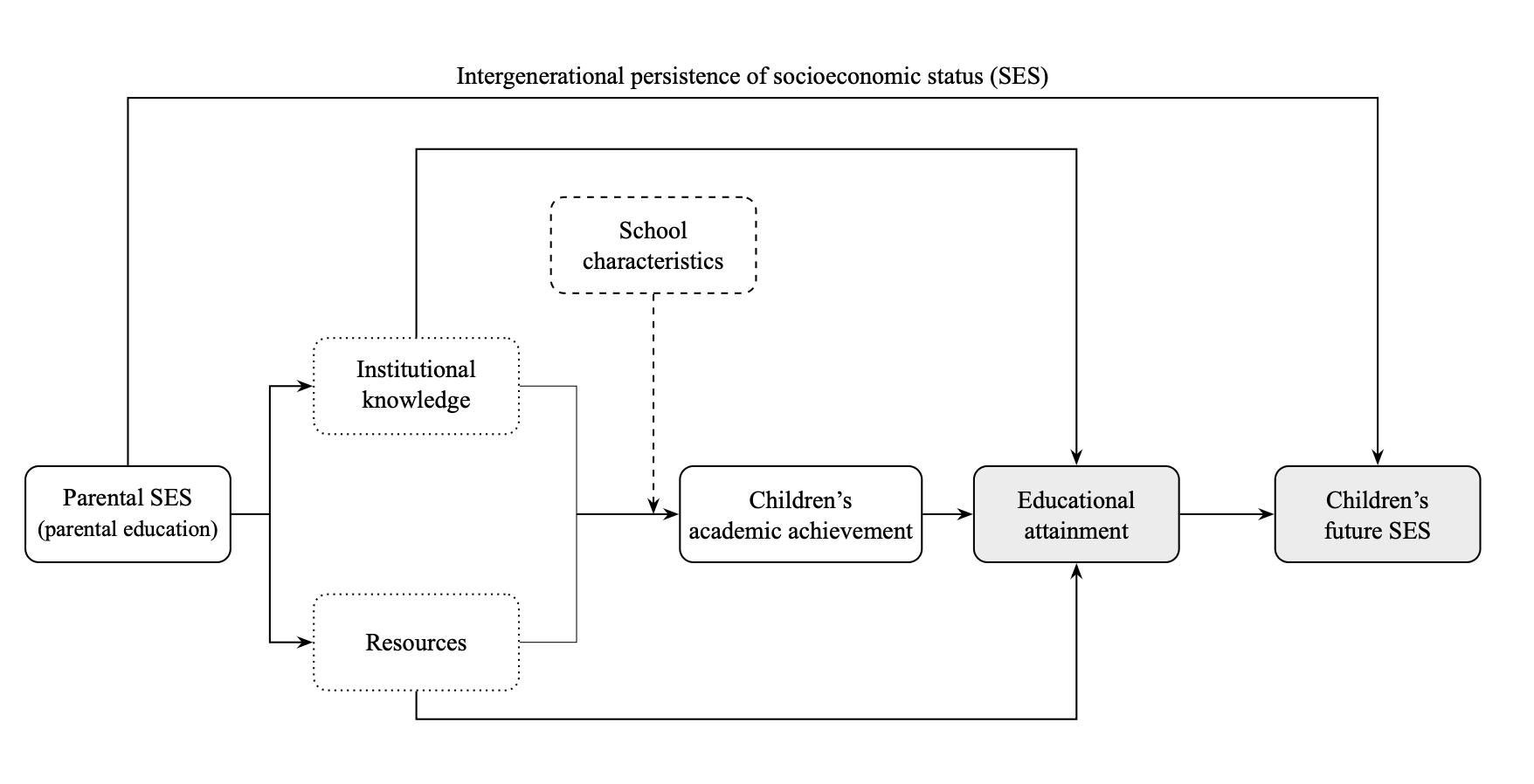
As illustrated in Figure 1, the framework proposed the relationships between family background, educational institutions and socioeconomic outcomes. Parental education is expected to influence children’s achievement through two mechanisms: (1) institutional knowledge and (2) resources. Educational institutions may then mitigate the relationship between family background and students’ academic achievement by providing additional support. Differences in academic achievement are in turn carried forward into educational attainment and ultimately shaping children’s socioeconomic status in adulthood.
Reference
Bittmann, F. (2024), ‘Investigating how early academic performance and parental socioeconomic status predict and explain successful completion of secondary education in germany’, Frontiers in Education 9, 1404076.
Blanden, J., Doepke, M. and Stuhler, J. (2022), Educational inequality, NBER Working Paper 29979, National Bureau of Economic Research.
Bukodi, E., Goldthorpe, J. H. and Zhao, Y. (2021), ‘Primary and secondary effects of social origins on educational attainment: New findings for england’, The British Journal of Sociology 72(3), 627–650.
Corak, M. (2013), ‘Income inequality, equality of opportunity, and intergenerational mobility’, Journal of Economic Perspectives 27(3), 79–102.
Foliano, F., Green, F. and Sartarelli, M. (2019), ‘Away from home, better at school: The case of a british boarding school’, Economics of Education Review 73, 101911.
Forster, A. G. and van de Werfhorst, H. G. (2020), ‘Navigating institutions: Parents’ knowledge of the educational system and students’ success in education’, European Sociological Review 36(1), 48–64.
Geven, S. and Zwier, D. (2025), ‘Students’ interactional cultural capital and academic performance in test- and teacher-based assessments’, The British Journal of Sociology 76(3), 622–634.
Krueger, A. (2012), ‘The rise and consequences of inequality in the united states’, Speech at the Center for American Progress.
Lasselle, L. and Smith, I. (2025), ‘Expectations of progression to university among pupils in rural communities: the role of social influences’, Oxford Review of Education 51(1), 72–92.
Lee, H., Shores, K. and Williams, E. (2022), ‘The distribution of school resources in the United States: A comparative analysis across levels of governance, student subgroups, and educational resources’, Peabody Journal of Education 97(4), 395–411.
OECD (2026), PISA 2025 Results (Volume I): Future-Ready Students, OECD Publishing, Paris.
Sen, A. (1999), Development as Freedom, Oxford University Press, Oxford.
Sheehan, J. and Hadfield, K. (2024), ‘Overcoming socioeconomic adversity: Academic resilience in mathematics achievement among children and adolescents in ireland’, British Journal of Developmental Psychology 42(4), 524–545.
von Stumm, S., Cave, S. N. and Wakeling, P. (2022), ‘Persistent association between family socioeconomic status and primary school performance in britain over 95 years’, npj Science of Learning 7(1), 4.
Yang, M. and Lee, H. J. (2022), ‘Do school resources reduce socioeconomic achievement gap? evidence from PISA 2015’, International Journal of Educational Development 88, 102528.